Team Communication in the Age of AI: Five Practices for Creative Teams to Get Conversations Back as the Division of Labor Shrinks
AI now produces first drafts of designs, writes code and polishes copy. In creative work, the range of what one person can handle alone has grown enormously.
At the same time, we hear things like this more and more: “We’re supposed to be a team, but I have no idea what anyone is thinking.” “New hires just aren’t growing.” “After delivery, we found a problem nobody had noticed.”
This article looks at what is happening to team communication as AI and remote work spread, and what creative teams need from here on. To give away the conclusion: what is being asked of us is not a new skill. It is an extension of what always mattered.
Key takeaways
- AI and remote work have reduced the division of labor, and with it the conversations that used to come as a by-product of handoffs.
- As a result, quality turns into a black box, decisions depend on one person, new hires don’t grow, and people feel isolated.
- If conversations no longer happen on their own, you create them on purpose through five practices, such as sharing decisions and building review into the process.
Note: this article is written by the developer of GeckoFlag.
AI has made more work something one person can finish alone
Not long ago, web production was split up as a matter of course. A director gathered the requirements, a designer made the mockups, a developer built them, and someone checked the result at the end. Between each step there was always a handoff.
Today, with AI, one person can take a large part of the work, from wireframes to implementation to adjusting the copy. With remote work spreading as well, much of the work now gets done on one person’s screen.
That in itself is a good thing. Work is faster, and even small teams can take on big projects. But as the division of labor shrank, something important and hard to see disappeared along with it.
Conversation as a by-product of the division of labor
When work was split up, every handoff naturally brought conversations like these:
- “How is this button supposed to behave on hover?”
- “Is this spacing wide on purpose?”
- “Is the client really happy with this wording?”
Exchanges like these caught misunderstandings, passed on the intent behind a design, and taught new hires how their seniors thought. The conversations were never the goal. They came about as a by-product of the division of labor.
When the division of labor shrinks, so does that by-product. In remote work, there are no questions or small talk drifting over from the next desk either. Team communication didn’t shrink because someone slacked off. It shrank because the structure of the work changed.
What happens to a team when conversation drops
1Quality becomes a black box
What AI produces usually “seems to work.” It looks polished, and at first glance nothing is wrong. But if no one reviews what is inside, security holes, accessibility gaps and bugs that only appear in certain environments get found after delivery.
2The reasons behind decisions are lost
The deliverables remain, but the “why” does not. Six months later, when the client asks, “Why did you structure it this way?”, no one can answer if the person who made it is gone. The work becomes tied to individuals, and only they know how it works.
3New hires don’t grow
Banner production, simple coding, small revisions: the entry-level work where new hires used to build experience is exactly what AI takes on first. New hires built their judgment through that work and the feedback they got from seniors on it. Skip that stage, and a few years from now there will be a gap where the team’s mid-level people should be.
4People feel isolated and lose the sense of contribution
When you can’t see who your work helped, or how, it is hard to feel it mattered. Finishing alone, delivering alone. It may be efficient, but the point of working as a team starts to fade.
Four team strengths that matter more in the age of AI
AI has greatly lowered the cost of making things. As a result, the human work that comes before and after making has become relatively more valuable. None of the four strengths below are new. And none of them work without conversation.
Grasping the client’s real problem
“We want to redesign our site” is a request. The real problem often lies elsewhere, such as “inquiries are dropping” or “we’re losing hires to competitors.” AI answers based on what it is given, so what you give it sets the ceiling on the output.
What you learn in client interviews should not stay in one person’s head; it should become the team’s shared understanding. Whether the team also shares things that rarely get said out loud, such as your contact’s position inside their company or past trouble with another agency, shapes the quality of the work.
Seeing beyond how things look
Security, marketing, page speed, accessibility. Now that it is harder to stand out on looks alone, quality in the parts no one sees is what sets you apart. No one needs to be an expert in all of it, but noticing a risk and bringing in someone who knows more is essential. Whether team members with different specialties speak up to each other determines how much ground the team can cover.
Making proposals no one else can copy
AI output tends to drift toward the “plausible average” of the data it learned from. When everyone uses the same tools, proposals start to look alike. The commoditization that began when work went digital is only speeding up.
What sets you apart is information AI doesn’t have: what you learned by visiting the site in person, the voices of end users, something the client mentioned in passing. And the perspective that comes from the team discussing all of this together. Originality is not about being flashy; it is about the client sensing that “this team thought this through for this project.”
Taking responsibility for decisions
When AI can produce option after option, the central role left to people is to choose, and to say with confidence, “This is ready to go out.” Quality holds when someone else checks that decision. A flow where one person makes, checks and delivers alone needs a second pair of eyes somewhere.
Team communication in the age of AI: five practices
If the division of labor no longer creates conversations, the only option is to design ways for them to happen on purpose. Here are five practices you can start tomorrow.
1Share decisions, not just deliverables
What you share should not be only the finished files. Keep a record of what you decided, why, and what you chose not to do. Three lines or so is enough.
An example decision record
- Decided: the main image on the home page will be an illustration, not a photo
- Why: photos of the facility will be out of date after the next renovation
- Not chosen: stock photos (we might end up with the same image as a competitor)
Where you keep it matters. Written in chat, it quickly scrolls away, so keep it somewhere tied to that piece of work or task. Then you can trace what happened later.
RelatedWhy exchanges in chat get lost is covered in Part 3 of our beginner series, “Why Do Requests in Email and Chat Get Lost?,” and how to set up decisions as tasks of their own is covered in Part 2 of the series “Task Management for Teams Working with AI,” “Frame Tasks Around What to Decide, Not Just What to Make”
2Build review into the process
The more AI made something, the more it needs a person to look at it. Put a review step between “in progress” and “done,” and decide in advance who will review. Reviews that rely on goodwill or spare time are the first thing to go when things get busy.
Reviews don’t only protect quality. They are also a reliable chance for conversation to happen within the team.
RelatedHow to make waiting states such as “waiting for review” visible with statuses is covered in detail in Part 3 of the series “Task Management for Teams Working with AI,” “Make “Waiting for a Decision” Visible”
3Divide roles by responsibility, not by task
Dividing work by tasks, such as “who designs” and “who codes,” is losing its meaning because of AI. Instead, divide roles by areas of responsibility: “who protects the client’s intent,” “who guarantees quality,” “who checks security.”
Where there are boundaries of responsibility, there are handoffs, and the conversations needed to check things come back naturally.
4Use sync and async on purpose, and design time for small talk
Records and reports go async; doubts and thinking things through out loud with someone go sync. In remote teams, if you don’t keep this split in mind, everything ends up as text.
We recommend setting aside about 15 minutes regularly to “talk about what you’re unsure of.” It is not a progress meeting, but a place where people can casually bring things they can’t decide on or that are bothering them. Think of it as deliberately creating the kind of quick consultation that used to happen naturally at the next desk. Whatever gets decided there goes into the task in a single line, as in the first practice.
5Move from growing new hires “by chance” to “by design”
With less entry-level work, an environment where people grow on their own no longer exists. Developing new hires has to be designed on purpose.
- Have them review AI output: asking them to explain what is good and what is not builds their eye for quality.
- Have them put the “why” into words: give them more chances to explain the reasons behind decisions, rather than just more work to do.
- Show how experienced people think: through pair work and the like, share the thinking process, not just the result.
- Let them own a small project from start to finish: at a scale where failure is fine, give them the experience of seeing something through with responsibility.
The decision records from the first practice become learning material for new hires as they are. An environment where they can trace what happened is, in itself, part of how people grow.
Communication with clients works the same way
All of this applies beyond the team itself. As production speeds up, clients get to see deliverables sooner. On the other hand, gaps such as “this isn’t what I pictured” also surface at shorter intervals.
That is why it matters to share the reasons behind decisions along with the deliverables, to align expectations early by being clear about what can and can’t be done, and to deliver bad news as early as possible. None of this is new advice, but now that AI has sped up the work, the difference shows up more clearly in the results.
RelatedHow to ask clients to review and decide is covered in Part 5 of the series “Task Management for Teams Working with AI,” “Keep Work Moving While You Wait for Client Approval”
In the end, the reason a client entrusts you with work is less about how many skills you have than about trust: “We can leave this to this team.” That trust only comes from careful communication, day after day.
Tools are for keeping conversations, not cutting them
Project and task management tools are often talked about in terms of efficiency: fewer meetings, fewer back-and-forths.
But in the age of AI, the role of tools shifts a little. AI handles much of the work quickly, so what we need from a tool is a place where conversations and decisions build up.
Chat scrolls away, but comments attached to a task stay with that work. Who is doing what, why it was decided that way, where a review is stuck: when that is visible, people who join later can trace what happened, and new hires can relive their seniors’ decisions as learning material.
RelatedHow the role of task management tools changes for teams working with AI is covered in the series “Task Management for Teams Working with AI,” starting with Part 1, “Now That You Use AI, Do You Still Need a Task Management Tool?”
How to do this in GeckoFlag
The five practices above work with any tool. As one example, here is how you can apply them in GeckoFlag, a self-hosted project management tool.
| Practice | How to do it in GeckoFlag |
|---|---|
| 1 Share decisions | Leave “Decided / Why / Not chosen” in the issue’s comments. You can search comment text with partial matches from the issue list. Collect recurring rules in the project’s wiki |
| 2 Build review into the process | Add a “Waiting for review” status. When you finish your work, post a comment and, at the same time, change the status to “Waiting for review” and the assignee to the reviewer. Check the Kanban board to make sure issues aren’t piling up in the review row |
| 3 Divide by responsibility | Give each project an owner (the person responsible) and assign each issue to one person. Create issue types such as “Quality check” and “Security check,” and decide who is responsible for each |
| 4 Use sync and async on purpose | Each time you post a comment, choose who gets notified, making it clear who you want to read it. Use reactions on comments to say “Seen it” and cut down on replies. Record what was decided in a sync conversation as a comment on the relevant issue |
| 5 Design how new hires grow | Add new hires as members of a project so they can read their seniors’ issues and comment history (members and guests can only see the projects they have joined). When you give a new hire a small project, make them its owner |
| Sharing with clients | Invite clients as “Guests” and show them only the projects they join. Guests can also edit issues and comment, so keep internal discussions in a separate project |
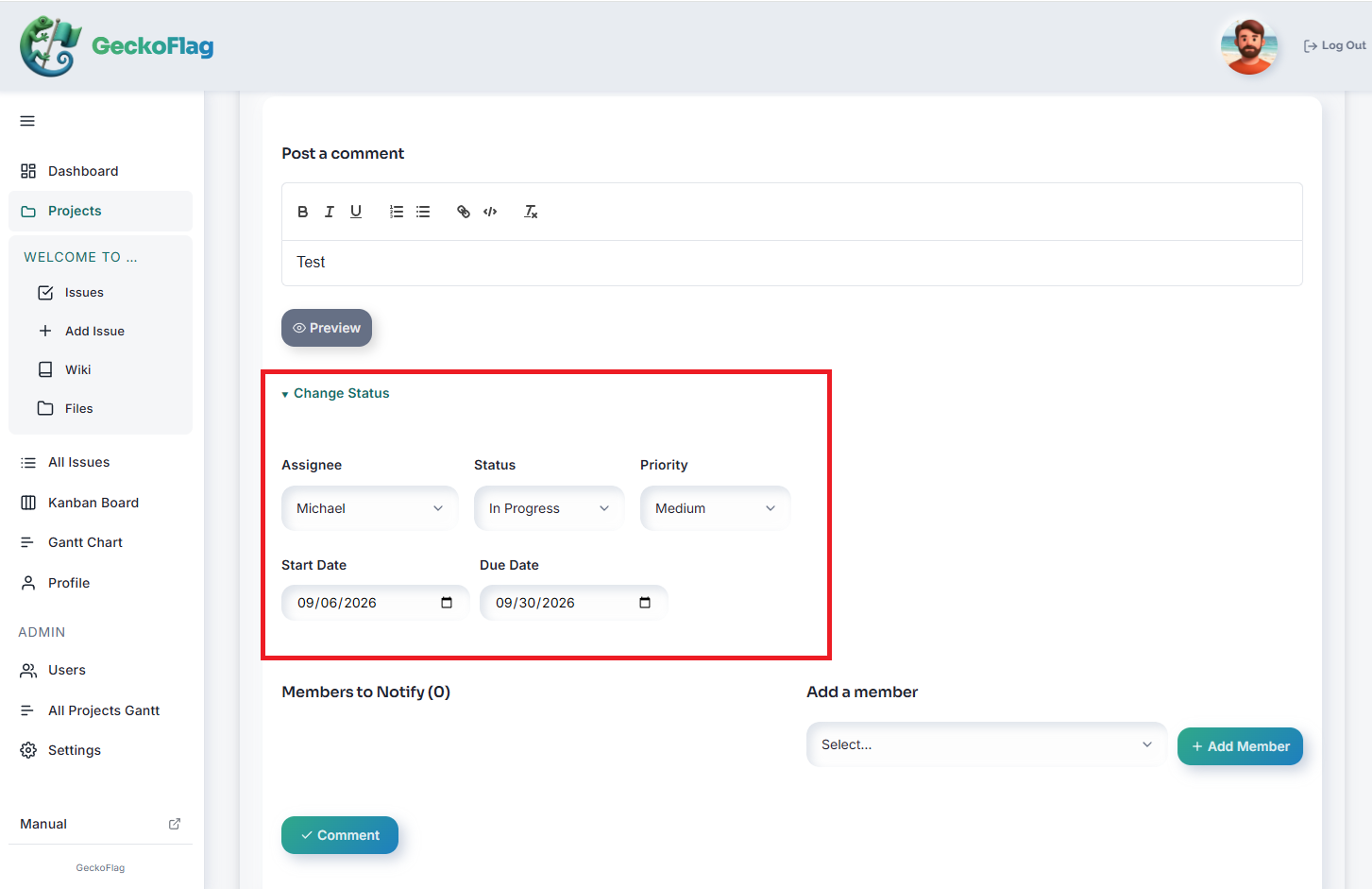
GeckoFlag has no workflow settings that prevent anyone from skipping review, and no automation features. “Go through waiting for review before marking it done” is a rule your team agrees on. In return, there are fewer settings, and you can start using it without confusion from day one.
Because you install it on your own server, even exchanges that include client information stay under your own control (managing the server is your responsibility). It is a one-time purchase of $30, with no extra charge as your team grows (server costs are separate, and if you use “Create with AI,” Anthropic API usage fees are also separate). You can try the actual screens in the demo.
Summary
- AI and remote work have reduced the division of labor, and the conversations that came as its by-product have dropped too
- As a result, quality turns into a black box, decisions depend on individuals, new hires don’t grow, and people feel isolated
- What is gaining value is grasping the real problem, seeing beyond looks, making proposals no one can copy, and taking responsibility for decisions. All of these were always needed
- If conversations don’t happen on their own, create them on purpose: share decisions, build in review, divide roles by responsibility, design time for small talk, and design how new hires grow
AI is not the enemy. The question is whether you can use the time AI frees up for conversations and decisions. Teams that keep treating the work itself as their value will struggle, while teams that value understanding, judgment, responsibility and trust will keep being chosen.